Abstract
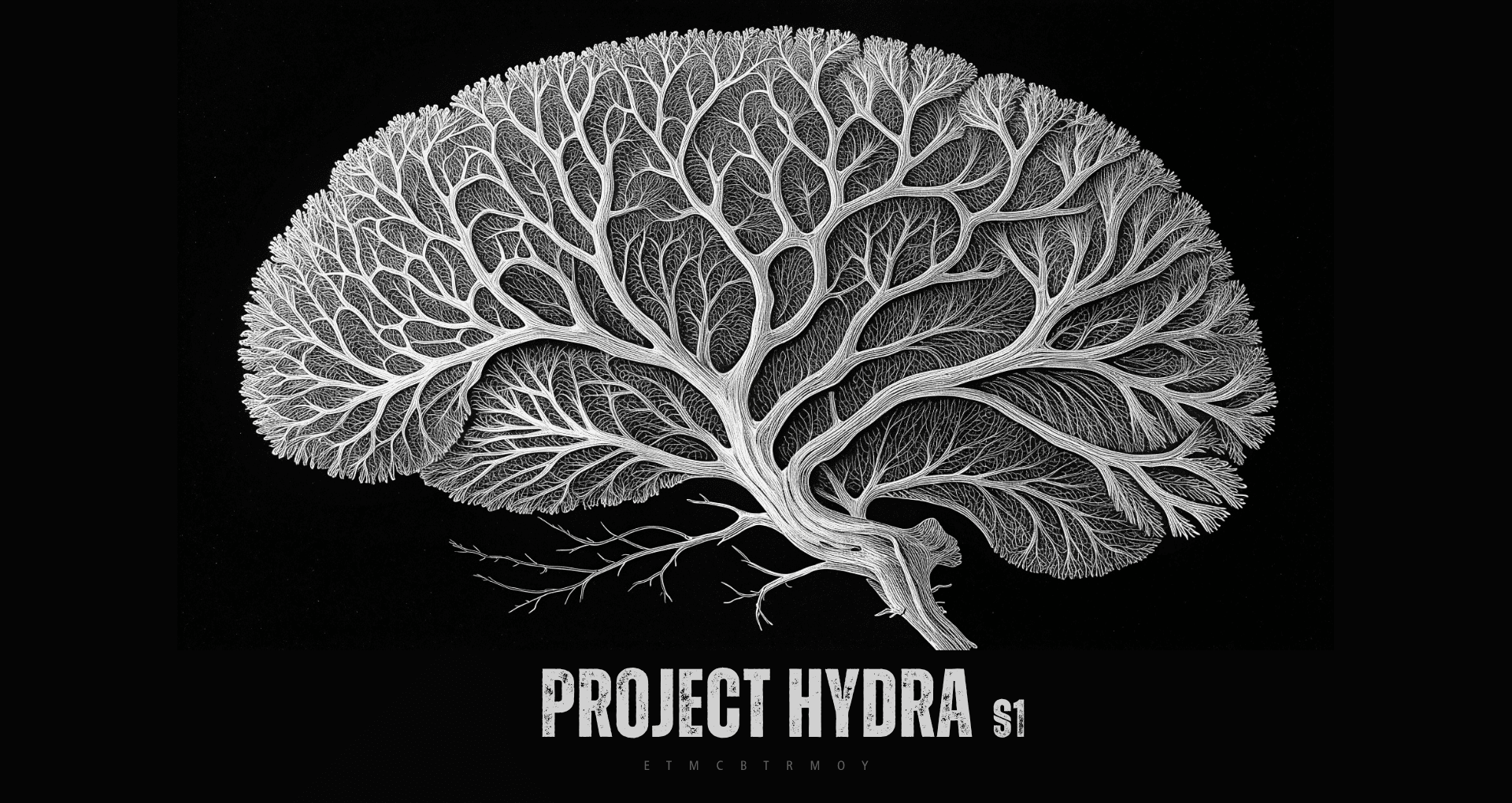
First in the Project Hydra series. The dream is an AI that genuinely knows you, that doesn't reset every morning, doesn't hallucinate your context away, doesn't ship your data to someone else's database. This article sketches what the architecture for such an AI would have to look like, names the project I'm building toward it, surveys the existing systems in the field, and identifies the slicing principle that determines what ships first. It is the opening of a written record I'll be building over the coming months.
---
Welcome back to another story.
Imagine an AI assistant that actually knows you.
Not in the marketing sense. Not "we use your data to personalise your experience." In the real sense. The way a senior engineer who has worked beside you for two years knows you. Knows what you're working on without being told. Remembers what you decided last month. Picks up a conversation from yesterday like it never ended.
You can sit with that thought for a while. It feels obvious. It feels like something the technology should already do.
It doesn't.
That is the question this article is about. And the answer turns out to be a real research and engineering programme, not because the dream is unreasonable, but because the architecture today's AI products are built on cannot deliver it. The architecture has to change. Concretely. Specifically. In ways I am going to walk through here.
---
What the Architecture Has To Look Like
Here is the part that took me a while to see.
An AI that "knows you" is not an AI with a bigger context window. Bigger context windows help, but they are a finite improvement on a fundamentally finite resource. A context window is working memory, what fits in the model's attention right now. No matter how big it gets, it cannot hold years of daily use. The math does not work.
What the architecture needs is something humans figured out a long time ago. The brain has multiple memory tiers, each with its own job:
Each tier has its own retrieval pattern. Each tier has its own update mechanism. None of them are a context window. They cooperate to produce something that, from the inside, feels continuous, but is actually being assembled, on demand, from durable storage every time you think.
An AI that consolidates the way the brain consolidates would not need infinite working memory. It would need a way to compress experience into structure, retrieve the structure on demand, and rebuild context turn by turn. From the user's point of view, one continuous conversation that never ends. From the system's point of view, every turn is a fresh assembly from durable storage.
That is the architectural shift. Not a bigger context window. A different way to remember.
---
And It Has To Be Yours
Here is the second part that has to be true.
Every personal-AI assistant currently shipping ships your data to someone else's server. That is not a side effect, it is the business model. Your conversations. Your context. Your memory, if these systems ever build long-term memory on top of you. All of it leaves your device, gets processed somewhere you cannot see, gets logged in ways you cannot audit, gets stored under terms-of-service that can change tomorrow.
The dream of an AI that knows you only works if the AI is yours.
Hydra is built local-first. On the phone in your pocket. On the machine on your desk. Connected over a private network you control. No cloud holding your context. No third-party API logging your conversations. No telemetry. No copies on someone else's hardware.
Nothing leaves.
That is not paranoia, it is the only architecture in which the relationship actually works. An AI that "knows you" while shipping the knowing-you to someone else's database is not really yours. It is theirs. On loan.
One chat. One AI. One relationship. Yours.
---
The Cinematic Frame
The cinematic version of this idea is Jarvis. And Friday. Tony Stark's AIs. Witty, omniscient, present, continuous. They know him because they have been with him.
The fantasy is real and it is useful as a north star.
But fantasies do not ship. What ships is a real artifact, defended on its own merits.
---
What Already Exists
There is good prior art. None of it solves the whole problem.
The most recent academic survey of memory in LLMs (Zhang et al., 2025) maps the field. It identifies the integration of these tiers, under a unified governance framework with verifiable update faithfulness, as an open problem.
That open problem is what Hydra is for.
---
The Project: Hydra
I am calling it Hydra.
Hydra has many heads, like the Greek monster, because the architecture has many components and removing any one of them collapses the whole. The cinematic Jarvis is what the user sees. Hydra is what is actually running underneath.
Five layers, in rough order from concrete to research-y:
Each layer has a job. None of them is invented from nothing, most have prior art in the field. The contribution is the integration: getting all five to cooperate as a single coherent assistant, on hardware you own, without asking permission.
That is Hydra.
---
The Slicing Principle
Hydra is a multi-year project. I am not pretending otherwise.
But the multi-year vision is not what gets shipped first. What gets shipped first is one carefully chosen slice, defended on its own merits, with a measurable contribution, against a real baseline.
That is not modesty. That is discipline. The fastest way to fail at a project this size is to try to ship the whole thing at once. The fastest way to succeed is to identify the one component that, if you get it right first, makes everything downstream possible, and to ship that one component well.
Which one?
That is the subject of the next article in this series.
---
What Comes Next
Series outline:
I am writing this here because I want a public record of when I started thinking about this. The field is moving fast. The slice I am targeting is missing from every shipping personal-AI product today. The date on this post is the date I planted the flag.
Welcome to Project Hydra.
---