You've probably used an AI chatbot. Asked it a question. Got a response. One prompt in, one answer out.
That's not where the frontier is anymore.
The frontier is AI agents that don't just respond, they coordinate. They delegate. They manage teams of other agents. And the results are quietly redefining what's possible in software engineering.
From Chatbot to Engineering Team
Here's the shift most people have missed: AI isn't just a tool you talk to. It's becoming a system you architect.
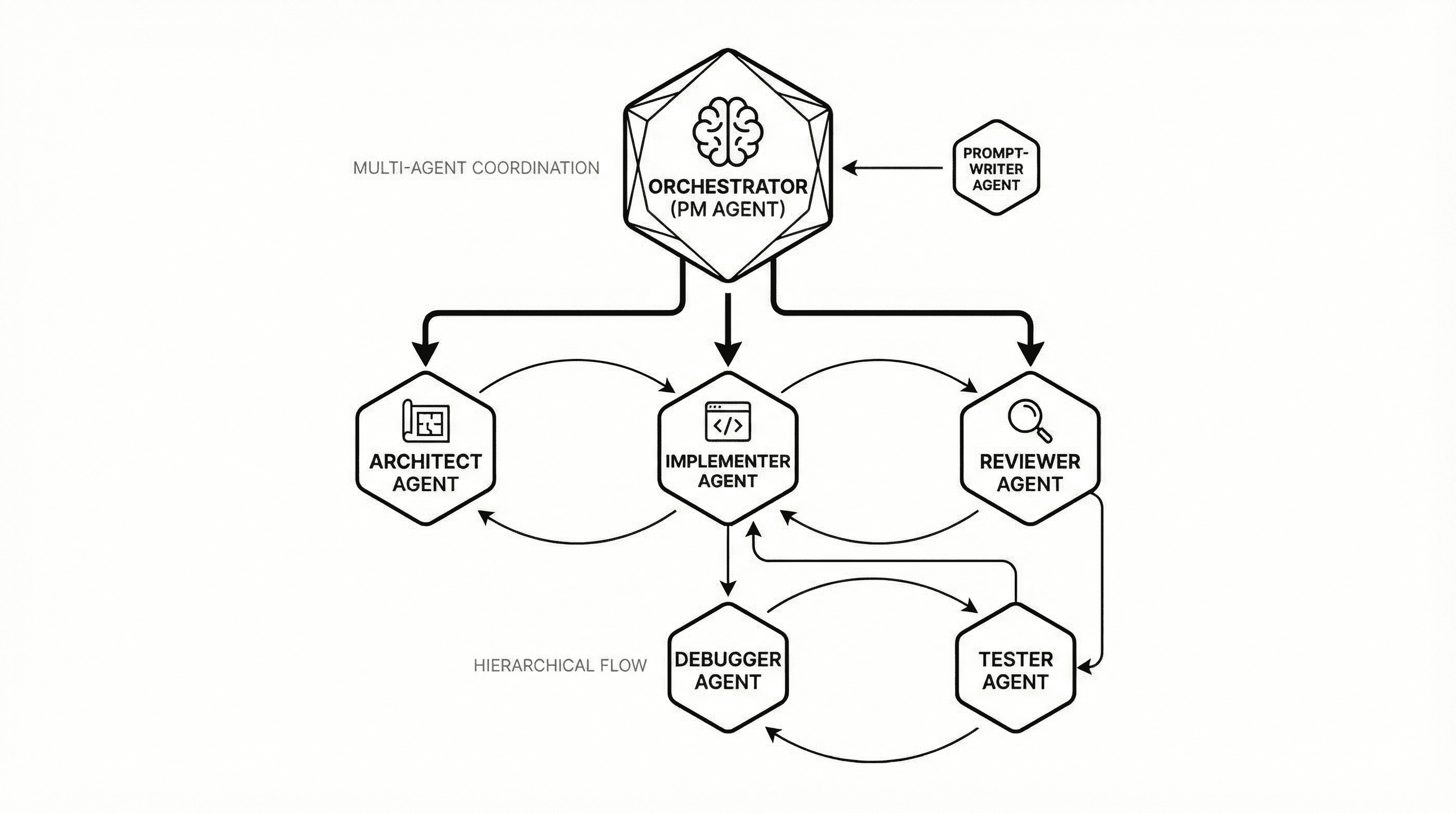
Imagine this. Instead of one AI doing everything, you design a hierarchy. An architect agent that designs systems but never writes code. An implementer agent that writes code but never makes architectural decisions. A reviewer agent that validates work but never modifies it. A debugger agent that diagnoses problems but never applies fixes.
Each agent has a defined role. Clear boundaries. Specific permissions. Sound familiar? It's how real engineering teams work.
The orchestrator sits at the top, coordinating everything. It reads the task, spawns the right agents, routes information between them, and ensures the output is coherent. It's a project manager that never sleeps.
Why This Matters
Single-agent AI has a ceiling. Give it a complex task, and eventually it forgets decisions it made earlier. It writes code and then reviews its own work, the same mind that introduced a bug is now responsible for finding it. It loses context. It contradicts itself.
Multi-agent systems solve this structurally. The agent that designs doesn't implement. The agent that implements doesn't review. Different "minds" checking each other's work, the same principle that makes human code review valuable.
There's a concept emerging called the "prompt-writer agent", a lightweight agent whose only job is to generate detailed, context-rich prompts for other agents. Instead of a vague instruction like "fix the login bug," it reads the codebase, identifies relevant files, pulls in conventions, and produces a structured task with clear acceptance criteria. The downstream agent starts with full context instead of spending half its resources figuring out what to do.
The difference in output quality is dramatic.
The Enterprise Reality
This isn't theoretical. Multi-agent architectures are being used to build production-grade software right now. Full-stack platforms with microservices, smart contracts, frontend applications, and infrastructure, coordinated by hierarchical agent systems.
Companies like Google DeepMind, Microsoft, and Anthropic are publishing research on agent orchestration. Open-source frameworks for multi-agent coordination are appearing monthly. The tooling is early but evolving fast.
And here's the part that should grab your attention: the principles that make multi-agent AI work are the same principles that make human teams work. Clear responsibilities. Separation of concerns. Explicit communication. Documentation. Hierarchy.
AI didn't invent these ideas. It made them non-negotiable.
The Takeaway
The AI you've interacted with is a solo performer. The AI being built right now is an orchestra, multiple specialised agents, each with a defined role, coordinated by an orchestrator that holds the bigger picture.
The question isn't whether AI can write code. It's whether AI can work in teams. The answer is yes. And it's already happening.