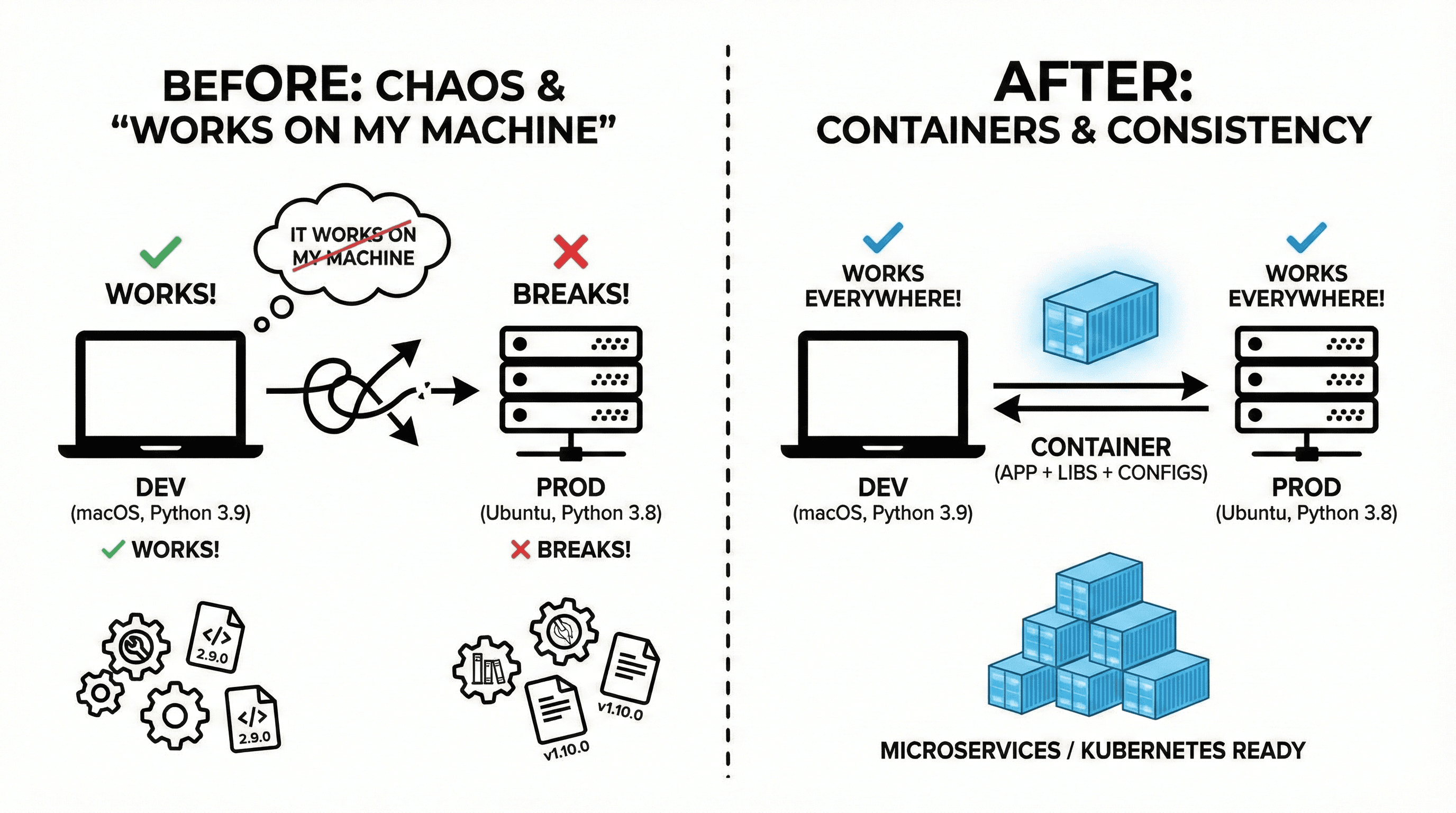
Every developer has said it. The code works perfectly on their laptop. They push it to production. It breaks. The server has a different operating system, a different library version, a different configuration. Hours of debugging follow.
For decades, this was just how deployment worked. Then containers arrived, and that problem essentially disappeared.
The Before
Before containers, deploying software was an exercise in managing differences. Your development machine ran macOS. The staging server ran Ubuntu 20.04. Production ran Ubuntu 22.04. Each environment had its own versions of Python, Node.js, system libraries, and configuration files.
Deployment checklists were pages long. "Make sure libssl is version 1.1.1. Make sure the timezone is set to UTC. Make sure port 3000 isn't already occupied." Miss one step, and the application fails in production while working perfectly everywhere else.
The solution at the time was virtual machines, entire operating systems running inside other operating systems. They worked, but they were heavy. A single virtual machine could take minutes to start and consume gigabytes of memory just to run one application.
The Shift
In 2013, Docker introduced containers to the mainstream. The idea was elegant: package the application and everything it needs, runtime, libraries, configurations, into a single, portable unit. That unit runs identically everywhere. Your laptop, a test server, a production cluster. Same container, same behaviour.
A container isn't a virtual machine. It doesn't need its own operating system. It shares the host's kernel and isolates only what needs to be isolated. The result: containers start in milliseconds, use megabytes instead of gigabytes, and you can run dozens on a single machine where you'd struggle to run three virtual machines.
What This Actually Enabled
Containers didn't just solve the deployment consistency problem. They unlocked an entirely new architecture.
Microservices became practical. Instead of one massive application, you could split your system into small, independent services, each in its own container, each deployable separately. The authentication service doesn't need to know or care about the payment service. They communicate over APIs and live in separate containers.
Then came Kubernetes, the orchestration layer. If containers are the shipping containers of software, Kubernetes is the port authority. It decides which containers run where, restarts them if they crash, scales them up when traffic spikes, and routes traffic between them.
Today, a single Kubernetes cluster can manage hundreds of containers across multiple servers. Applications that serve millions of users run on this infrastructure. Netflix, Spotify, Airbnb, all container-orchestrated at massive scale.
And here's what most people don't realise: you don't need a massive budget to use this. K3s, a lightweight Kubernetes distribution, runs on a server with just 512 megabytes of RAM. The same orchestration technology powering billion-dollar platforms is available to a student with a $5 virtual private server.
The Numbers
Over 90% of organisations now use containers in production. Kubernetes is the most adopted container orchestration platform globally. Docker Hub hosts over 14 million container images.
This isn't emerging technology. It's established infrastructure. And yet, most people outside of DevOps don't fully grasp how fundamentally it changed software delivery.
The Takeaway
"It works on my machine" used to be an unsolvable problem. Containers turned it into a non-issue. What started as a packaging tool in 2013 became the foundation of modern software infrastructure, microservices, orchestration, cloud-native architecture, all of it built on the simple idea that software should run the same way everywhere.
The next time you use any modern application, there's a good chance it's running inside a container. Quietly, reliably, identically, no matter where in the world the server sits.