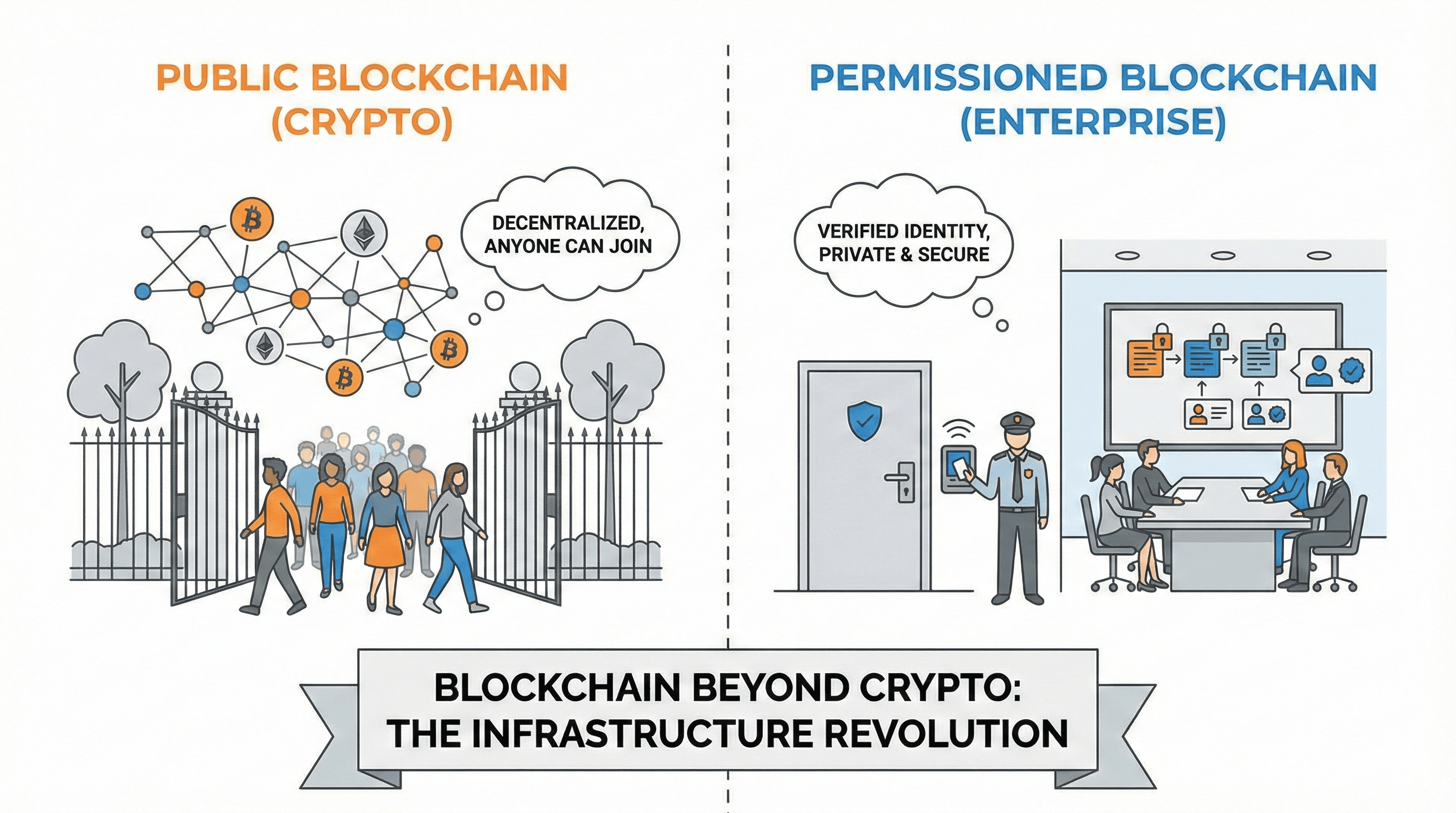
When most people hear "blockchain," they think of cryptocurrency. Bitcoin. Ethereum. Volatile markets and speculative trading.
Here's what they don't know: the most interesting blockchain work happening right now has nothing to do with crypto.
The Enterprise Secret
There's an entire class of blockchains that you can't buy tokens for. You won't find them on CoinMarketCap. They don't have flashy whitepapers promising 1000x returns.
They're called permissioned blockchains. And they're quietly running inside some of the largest organisations on the planet.
Walmart uses a permissioned blockchain to track food from farm to shelf. When there's a contamination scare, they can trace the source in seconds, a process that used to take weeks. Maersk, the shipping giant, tracks cargo across 90+ partners on a blockchain-based supply chain network. India's National Health Authority is exploring blockchain for unified health records across a country of 1.4 billion people.
None of these run on Bitcoin. Most of them run on Hyperledger Fabric, an open-source framework built specifically for enterprises.
What Makes It Different?
Public blockchains like Bitcoin let anyone join. That's the point, no gatekeepers.
Permissioned blockchains flip that model. You need authorisation to participate. Every participant has a verified identity. Every transaction is visible only to the parties who need to see it.
Think of it this way: Bitcoin is a public park. Anyone can walk in. A permissioned blockchain is a members-only boardroom. You know exactly who's at the table, and what's discussed stays in the room.
This matters for enterprises. A hospital can't put patient records on a public chain. A government treasury can't broadcast financial operations to the world. A supply chain network doesn't want competitors seeing its logistics data.
Permissioned blockchains solve this. Identity management, private data collections, channel-based isolation, the architecture is built for confidentiality, not speculation.
Why You Haven't Heard About It
Crypto dominates the headlines because volatility sells. "Bitcoin hits $100K" gets more clicks than "Walmart traces mangoes in 2.2 seconds."
But here's the reality: the enterprise blockchain market is projected to exceed $94 billion by 2027. That's not speculative, it's infrastructure. Real companies solving real problems with real deployments.
The smart contracts on these networks aren't DeFi protocols. They're supply chain verifications, KYC compliance checks, government treasury operations, and cross-border trade validations. Code that handles real assets, real identities, and real regulatory requirements.
The Takeaway
The next time someone says "blockchain is just crypto," they're seeing 10% of the picture. The other 90% is being built quietly, in enterprises, in governments, in healthcare systems, where the technology is solving problems that have nothing to do with trading tokens.
Blockchain's real revolution isn't financial. It's infrastructural. And most people haven't noticed yet.